Your child is not the problem
A letter to the mother who is quietly falling apart while everyone tells her to "just be patient."

You love your child. And some nights, you don't like your life at all.
You wake up already braced for it. The fight over the uniform. The breakfast that goes cold because he won't sit still. The teacher's message that makes your stomach drop before you even open it.
You spend the whole day negotiating, repeating yourself, raising your voice — then hating yourself for raising your voice. By evening, you're running on nothing. And when the house finally goes quiet, you sit in the dark and wonder the thing you'd never say out loud:
Am I a bad mother? Why can't I manage my own child when everyone else seems to manage theirs?
I have watched many mothers ask themselves that exact question in my office. Here is what I tell every one of them:
You are not a bad mother. You are an exhausted one. And you may have been fighting the wrong battle.
It isn't defiance. Sometimes it's a skill that still needs support.
Your child is not being difficult to frustrate you. He is not spoiled. You did not "fail to train him." ADHD can affect how a child manages attention, impulses, transitions and everyday tasks. So when you say "just sit still" or "just focus," you may be asking for a skill his brain finds genuinely hard to produce on demand.
It's also why he can lose himself completely in a game but can't stay with homework for five minutes. His attention isn't broken — it's regulated differently, especially when a task is repetitive or less interesting to him. Once you understand that, much of what he does begins to make sense.
The behaviour is a signal.
Every meltdown, every forgotten instruction, every "he just won't listen" is a clue about where a child may be struggling. Punishing the signal without understanding it is like breaking a smoke alarm to stop a fire.
 Perpetua Muokwe
I'm Perpetua Muokwe.
Montessori Educator · Certified Special Needs Therapist · School Director, Light Showers Montessori School, Lagos
For more than a decade, children who learn differently have been my life's work. Families come through my Learning Support Unit — many after every other door has closed. Schools that gave up. Reports that said "lazy," "stubborn," "not living up to potential." Professionals who called these children a "problem" and left it there.
I have sat with those children. And I have sat with their mothers — hollowed out, carrying a shame they can barely put into words. One looked down at her hands and said:
"I don't know if I'm a good mother anymore."
I understood the pain. But I had the training to look past the behaviour and ask what the child was actually struggling with. I took everything — my Montessori training, my SEN certification, and the patterns I've seen across many children — and built it into a system simple enough to work in a real home, run by a tired mother after a long day.
You have not failed. You just never had the map. Let me give it to you now.
Progress often begins with small moments that once felt impossible.
I won't promise a perfect 30-day transformation. Every child is different. But as you work through the system, this is the shape change often takes.
You begin handling transitions differently. The morning may still be hard, but it doesn't have to end in shouting.
He follows a two-step instruction and finishes it. A small thing. Small things matter.
The morning routine starts to feel more predictable.
You catch a moment of cooperation you might once have missed.
"I did it myself."
Not a perfect home. A child with 30 days of practice and small successes behind him — and a mother who understands him better than she did before.
Real homes. Real changes.
My child has been in Perpetua's school for three years. This is the same method they use with him there, and when I started doing it at home too, things changed. He is calmer, and I finally understand why he does what he does.
LagosWe did an online session with Perpetua for me and my son, and she explained things about him that nobody had ever explained to me before. The first week was still hard — I won't pretend it wasn't — but by the second week the evenings were not what they used to be. Thank you very much, ma'am.
AnambraThe food guide is the real gem for me. A small change to my daughter's meals, and I noticed a real difference in her afternoons and evenings. Wonderful work.
NairobiAs a health worker, I have read a lot on ADHD, but this one is different because it is practical. I have two daughters living with ADHD and we started with the decompression activities. It is working for us. There is calm in this house again.
USAA complete at-home support system
The system I use in my own Learning Support Unit — the whole thing, in plain language, built for real homes and real, tired parents.

Your Child Is Not The Problem
Understanding the ADHD brain
A simple, shame-free explanation of why your child may struggle with attention, impulses, transitions and everyday tasks — so you can begin responding differently.
Reading the behaviour behind the behaviour
My signature approach to seeing meltdowns, forgetting and difficult behaviour as signals — and learning to respond rather than react.
Working with your child's school
Your child's support shouldn't stop at home. Approach the school as a partner, not an adversary — prepare for a meeting, explain your concerns clearly, and ask for a documented support plan where appropriate. Includes ready-to-use advocacy scripts for exactly what to say.
The 30-day activity change
Your day-by-day map — what to do, in what order, using materials you already have at home. No complicated equipment.
Redesigning the transition hour
How to think differently about the hard stretch between the school gate and the homework desk — decompression, a predictable arrival routine, movement, and when to introduce homework.
Giving instructions his brain can hold
Small changes in how you communicate that make instructions clearer and easier for him to follow.
When it's hard
Because there will still be difficult days — and you deserve a strategy for those too.
Two bonuses that turn understanding into action
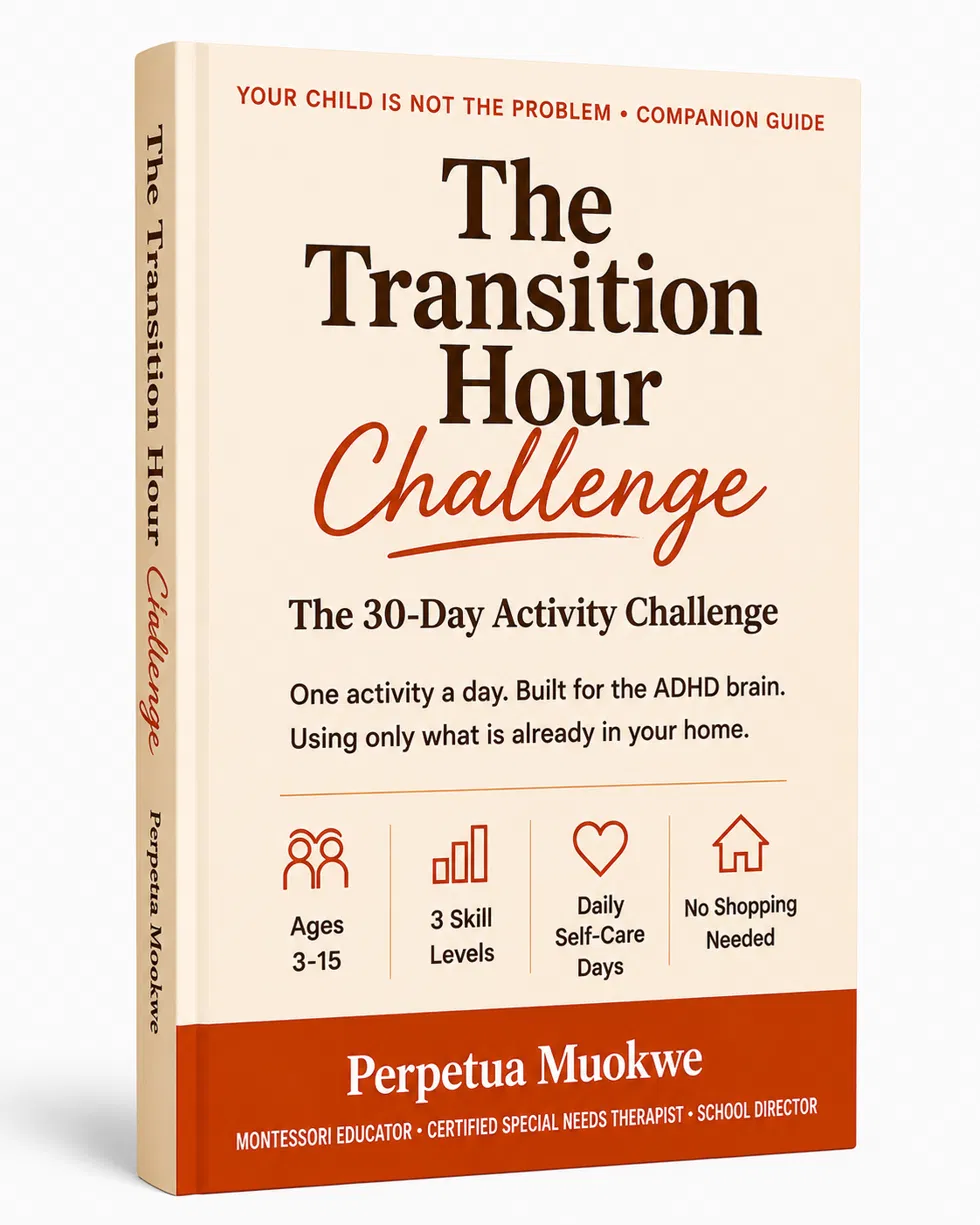
The Transition Hour Challenge
A structured 30-day companion. One activity a day, three developmental levels — Foundation (3–6), Building (7–9), Leading (10–15). Targets executive function, working memory, regulation, impulse control and confidence. Your "just tell me what to do today" companion.
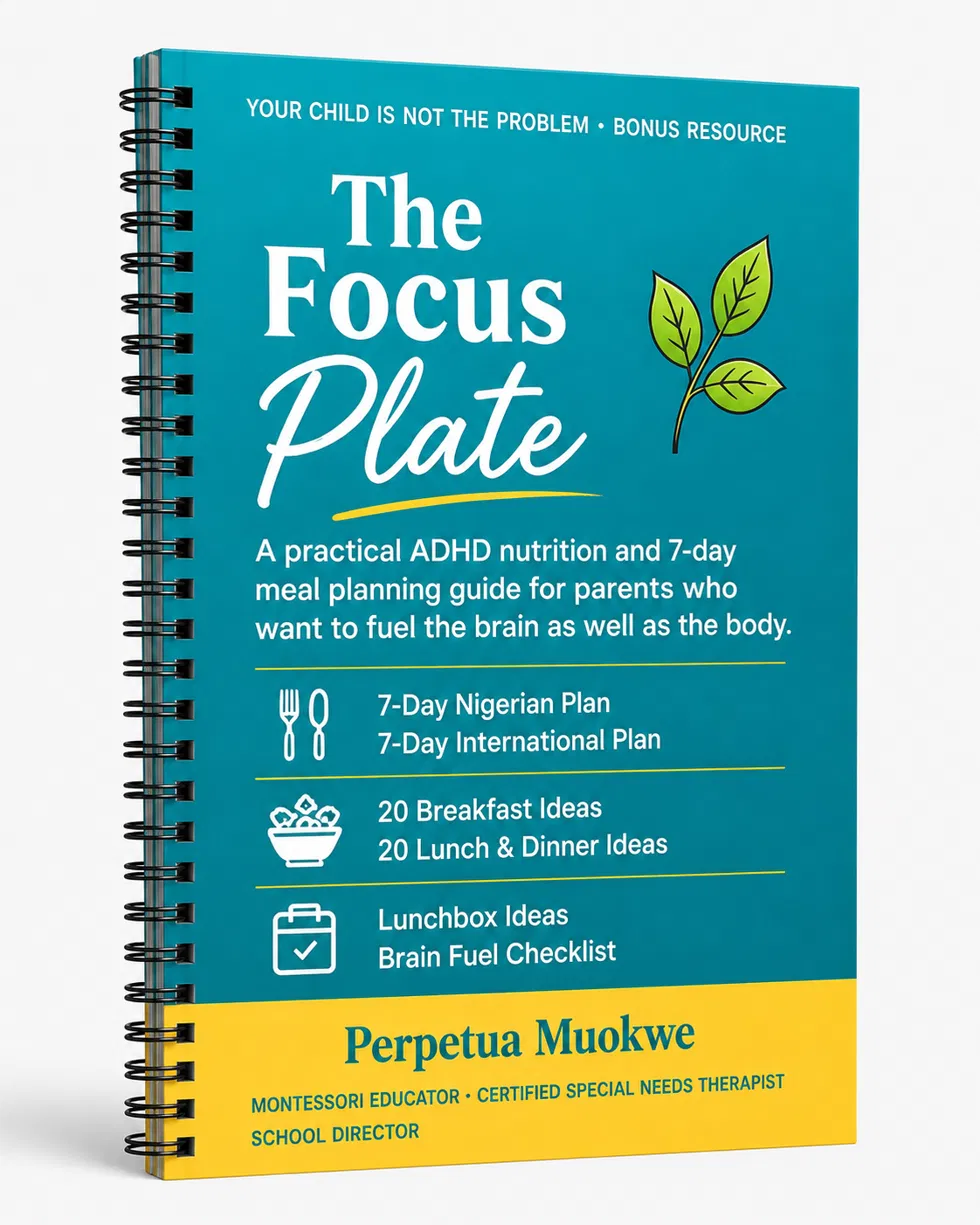
The Focus Plate
Practical nutrition that fits real family life. A 7-day Nigerian plan and a 7-day international plan, 20 breakfast ideas, 20 lunch & dinner ideas, lunchbox suggestions and a brain-fuel checklist. Simple food, familiar ingredients.
Three resources. One practical system.
- The Main Guide — Your Child Is Not The Problem
- The Transition Hour framework & 30-day action plan
- Parent–school advocacy guide & ready-to-use scripts
- Bonus 1 — The Transition Hour Challenge (30 activities, 3 levels)
- Bonus 2 — The Focus Plate (Nigerian + international meal plans)
Have a question before buying? Message me directly — I'm happy to help.
Same child. A different way of understanding him.
Close this page
Tomorrow starts the same way — the same fight over the uniform, the same cold breakfast, the same message from school, the same voice at midnight asking if you're the problem. Nothing changes, because nothing changed. You already know this road.
Try something different
Start building calmer transitions. Start understanding what sits underneath the behaviours that have been exhausting you. Walk into your next school meeting with better questions and real confidence. Start hearing "I did it myself" — because you finally started using a different map.
You picked up this guide because you love your child. Maybe you're tired. Maybe you've wondered whether you're doing enough. Please hear me: you are not a bad mother. Your child is not a bad child. And you don't have to figure everything out overnight.
Start with one change. One routine. One transition. One conversation with the school. One small chance for your child to feel "I can do this." That's where change can begin.
Your child is not the problem. You were never the problem either. You just needed a map.
— Perpetua Muokwe
P.S. Remember the 60-day guarantee. Give the guide a genuine try. If it isn't right for your family, request your refund under the guarantee terms.
P.P.S. Your child is not the problem. He never was. He's a child who may need the adults around him to understand how he learns, regulates, transitions and responds to the world. I've spent many years learning how to support children like him. Tonight, I can hand you what I know. Let's begin.